

Manufacturing companies are under increasing pressure from new technologies, new competitors and stagnating markets. Customers expect more variants, while at the same time the number of units per model is falling and costs are rising. In Germany, high wage and energy costs and a shortage of skilled workers are adding to the pressure.
Three key findings
- Lean manufacturing avoids waste such as overproduction, inventories and waiting times through consistent efficiency.
- Separate fast movers from exotics using Pareto analysis to achieve harmonious batch sizes and low congestion.
- Control before the bottleneck with pull and keep setup levels at 5-15% to ensure stable processes.
The challenges facing industrial production are constantly increasing. New production processes, new materials and new competitors with new products are entering the market. This increases competitive pressure especially in a market that is only showing limited growth or is stagnating. At the same time, existing customers are becoming more demanding, which is why the number of variants is increasing and the number of units per variant is falling. In Germany in particular, rising manufacturing costs due to high non-wage labor costs and energy costs as well as an increasing shortage of skilled workers on the store floor are also leading to further burdens.
This is the area of tension in which many manufacturing companies operate.
Company with production
This article will focus on a specific type of manufacturing company: Companies that have at least partial manufacturing processes in terms of the following characteristics:
- Production of discrete articles (no process industry / chemical industry)
- The manufacturing processes usually consist of primary forming (e.g. injection molding), forming (e.g. bending), machining processes (e.g. turning) or coating processes
- Various items can be produced at the workstations
- When switching from one article to another, set-up times are incurred, which is why batch or order-based production must be carried out
Lean manufacturing
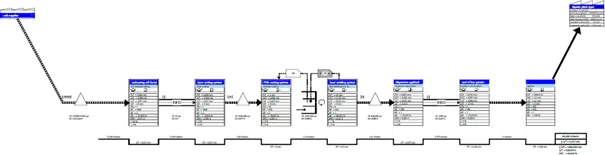
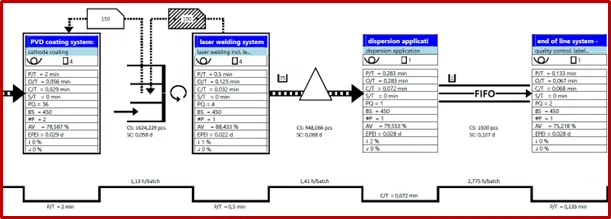
These manufacturing companies are increasingly confronted with the challenges mentioned above. As many of these challenges cannot be influenced, the companies' room for maneuver lies primarily in the Design of the production itself. This should be lean, i.e. streamlined. The idea is to continuously process the product from the start of the production process to completion. Any waste (overproduction, stocks, transportation, waiting time, time-consuming processes due to unsuitable resources, long distances, rejects/rework) should be avoided and all production factors (machines, systems, personnel, means of transport, equipment, tools, materials) should be used efficiently. As an aid for visualizing the production processes, the Value stream as it provides a quick overview of the key figures (see Figure 1).
Concrete options for action
For manufacturing companies, this raises the question of how to avoid waste and what to look out for. The following options for action focus on ways to Avoidance of overproduction, stocks and waiting times as well as the use of suitable resources.
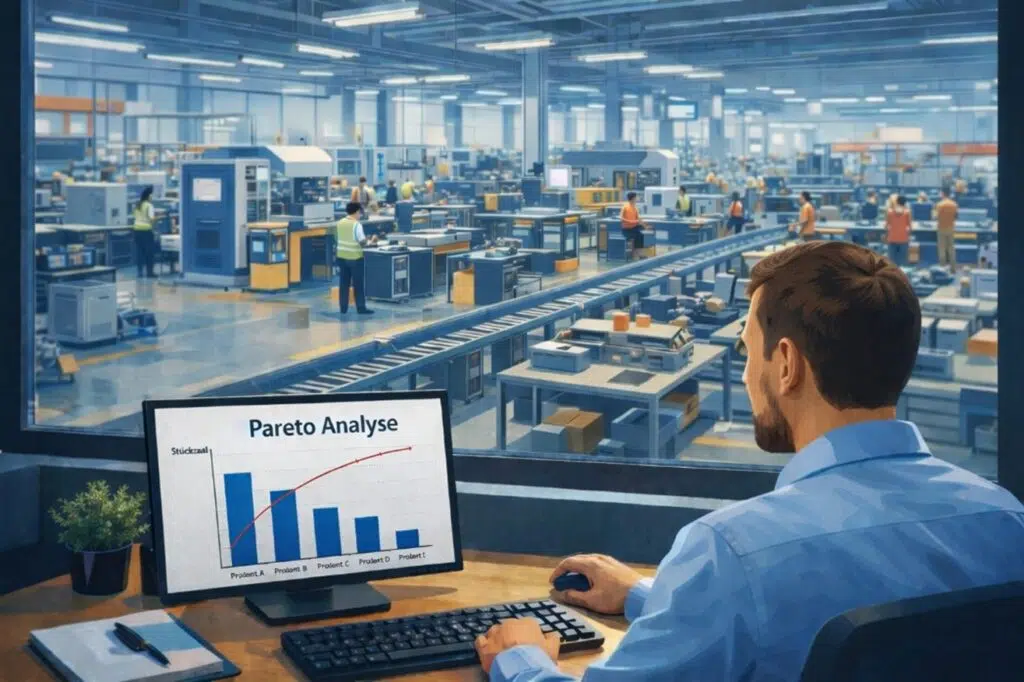
First of all, it is necessary to know exactly which products are manufactured, i.e. to find out which products are fast movers and which products are exotic, for example with the help of a Pareto analysis (see Figure 2).
This is necessary because the way in which fast-moving and exotic items can be processed efficiently differs. While fast-moving items are characterized by high quantities and a certain regularity in customer call-offs, the predictability in terms of quantity (order size) and regularity of an exotic item is low. The regularity of customer call-offs for fast-moving items offers the opportunity to produce in production batch sizes determined by the company itself, irrespective of customer orders. The main difficulty therefore lies in the definition of the optimal batch sizes.
Lean manufacturing means systematically avoiding waste and consistently using resources efficiently, from overproduction to rejects and rework.
Before these can be defined, it is necessary to check whether a physical separation of exotic and high-speed items makes sense, i.e. whether it is possible to use different machines and systems for the production of exotic and high-speed items. If all items are produced at one workstation, the processing sequence includes high-speed and exotic items, i.e. long and short production times (sum of set-up time and processing time of a batch) alternate. This leads to a „traffic jam“ in front of the workstation and therefore to high stock levels and long throughput times. In contrast, a Separation of exotics and fast movers the definition of harmonized production lot sizes only for high-speed production runs (the document duration of a production lot is very similar for all high-speed production runs), which leads to lower inventories and shorter throughput times.
Another starting point that needs to be considered when defining optimal batch sizes is the Bottleneck process. This has an influence on both the batch size and the control system. Depending on the utilization of the bottleneck process and the degree of set-up (proportion of set-up time to occupancy time), an initial estimate of the harmonious, optimum production batch size can be derived for the high-speed machines. The rule of thumb here is The setup level should not exceed 15% and not fall below 5%, The higher the capacity utilization, the lower the degree of setup. This rule of thumb provides a good ratio of machine and setter utilization on the one hand and space consumption for the transport aids/containers on the other. It is not possible to make a general statement on the optimum degree of set-up, but always requires a company-specific assessment.
Differentiating between fast-moving and exotic products is key to effective lean measures, because both product types require different planning, batch sizes and control logics.
Also from the point of view of Production control the bottleneck workstation can be regarded as decisive. It therefore makes sense to control all processes upstream of the bottleneck work center with pull, while all downstream processes can (but do not have to) be controlled with push. This prevents a backlog from forming before the bottleneck and ensures that there is only a maximum of one production lot size (=KANBAN lot size) of each fast-moving item before the bottleneck process. Only when the stock is reduced due to a withdrawal before the pull-controlled work station is a production order in the amount of the defined production batch for the previous work station triggered.
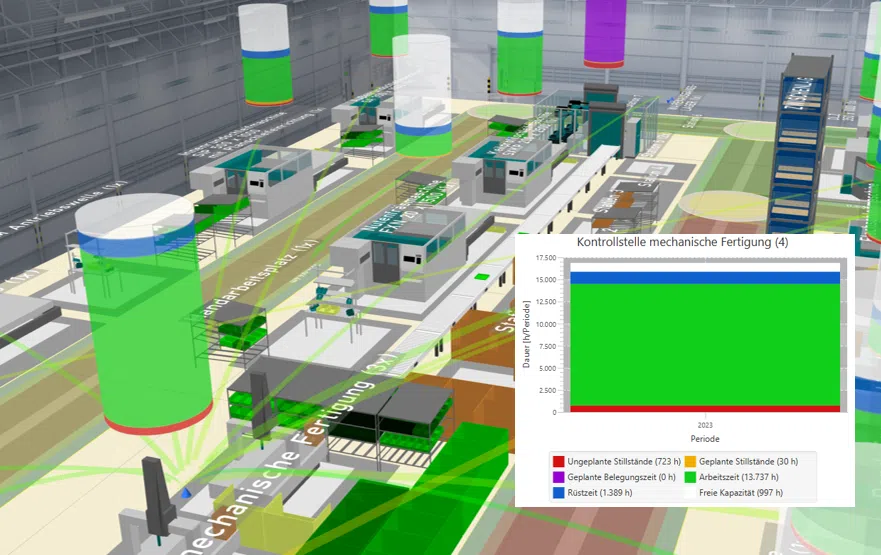
Since the interrelationships described above are highly interdependent and therefore not easy to analyze or evaluate, this task can often only be accomplished with Software support (e.g. ema Plant Designer) can be carried out quickly and meaningfully.
Summary & conclusion:
In order to ever-increasing challenges To master the challenges of industrial production, it is necessary to streamline production and avoid waste. When implementing specific measures, it makes sense to differentiate between so-called fast-moving and exotic products. Depending on the quantity distribution or regularity of the various products, different control principles and adapted production batch sizes help to avoid inventories, waiting times and overproduction. Suitable planning methods and software solutions can help to analyze and evaluate their effects at an early stage and thus contribute to maintaining competitiveness in the long term.
The bottleneck and setup level are the levers for stable flows, sensible batch sizes and a control system that limits stocks before the bottleneck, for example using pull principles.
What is the goal of lean manufacturing in one sentence?
The aim is to achieve a continuous flow of value with minimal waste so that throughput times are reduced and productivity increases.
Which types of waste should companies address first?
Focus on overproduction, inventories and waiting times because they directly increase throughput times and capital commitment and often trigger chain effects.
Why do I have to divide my products into fast movers and exotics?
Because fast movers are more predictable and more suitable for standardized, harmonized batch sizes, while exotics are more order-driven and less predictable.
What are the benefits of physically separating fast movers and exotics in production?
It reduces the risk of congestion and changing occupancy times at a workstation, which typically reduces inventories and throughput times.
What role does the bottleneck play in batch size and control?
The bottleneck sets the pace, so it makes sense to control upstream processes with pull and limit stocks, while downstream processes can run more with push.
Arrange a non-binding consultation on lean manufacturing now, We analyze your value streams, bottlenecks and batch sizes and identify specific levers for lower inventories and shorter throughput times.
Andreas Opitz
Head of Factory and Logistics Planning